
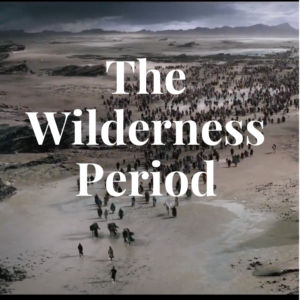
This summer at Riviera we are studying the book of Exodus. Being the first Sunday in July, I am now realizing just how LOOOOONG this book is and how hard it is for us to get a full sense of its totality in just a few months. In the past few weeks, the Israelites escaped their captivity and enslavement by fleeing Egypt, and then crossed into the Sinai Peninsula by creating and crossing a dry sea. All this was done by God because of his love for his people. They were on the way to their promised land.
And today’s chapters 15-18 are about the beginning of this wilderness trip they take to get there. And let’s just say they were not going to get ‘Best Camper Award ‘for their behavior during the sojourn.
AND granted the Israelites were not given a lot of warning about the Passover night and probably were more concerned that night with putting the blood of the lambs or goats on their door frames so that their first born children would not be killed than to think about the provisions they needed for their long journey to the promised land….. The Bible says they carried all this gold and silver that the Egyptians had given them. Perhaps it might have been smarter if they had collected dried fruits and vegetables and salted meats. Less than two weeks after their joyous celebrations of crossing the sea safely and drowning the Pharaoh’s army, they have forgotten the marvelous things God has done for them.
Their complaints are who can live by words alone? They are hungry, they are thirsty, and they are… well…whiners. And God continues to be responsive to these complaining group whom God calls God’s own. The people’s faith erodes with the dunes of the desert and they complain they were better off as slaves in Egypt. They sound ungrateful. They sound disloyal, but God’s blessing and graciousness pervade this whole narrative section. God is patient, God shows mercy, and God’s people are like adolescences with attitudes. The people complain and God responded with absolutely no anger. God says God will rain bread upon them and not just provide the Manna, but God will provide water, and God will provide quail.
So, the first thing I hope you take from this story is that God PROVIDED. God did not abandon God’s people in their fear and peril, but was there for them.
God made ground rules about the food though. In the 16th chapter, it is described how they are only to collect what was needed for the day. There was plenty, but it could not be stockpiled or it would go bad. The shelf life was short. Worms quickly turned it inedible. They were told that only on the day before they practiced Sabbath each week could they collect more food than a daily supply and that was so they did not have to collect food on their Sabbath.
So, Sabbath Keeping…. Taking a day to rest and reflect on the blessings we have been given and our gratitude for them is an important part of life. I guess that is why it saddens me when school sports and other activities have cheapened the idea of a Sabbath day. It is good, it is wholesome, and it puts the rest of the week in perspective when we take one day out of a week and to reflect… to think about the ethics we want to live by, and to be thankful for all that we have been given.
But on the other 6 days we collect the amount needed for the day. And this should sound a little familiar to us. We pray each week for our daily bread in the prayer we pray which follows Jesus’ teachings. We are to only be concerned about our daily sustenance… not hoarding more than we need. I can think of several reasons for this rule.
First is that hoarding the food would mean that you did not have faith that God would continue to provide. A God who would take away someone’s food is a God who is controlled by the behavior and practices of the people. And time and time again we have learned here that God will do God’s work independent of the behavior of God’s chosen. God says ‘I am Who I am’ or I Will Be Who I will Be’. A God like ours is not swayed by our whines and demands but is a constant presence in our lives.
Second is that hoarding things means that some will have more while others have little. That is not what God intended for God’s creation. God created a balanced ecosystem which is good as long as the balance takes priority over the want of an individual to control. Should we use all the natural resources and not have them available to others? What if our misuse causes others to suffer, to be hungry or thirsty? This would go against God’s plan. God does not say to build a barn to store things but instead to rely on God for our daily needs. And I have to say that I think of this when I hear that in other parts of the world there are draughts, where children go to bed hungry, where children do not have fresh air to breathe, where children live in areas polluted and poisoned by others waste, other’s greed, and for other’s comfort. It makes me think of the spoiled manna. Can we allow personal gain to force others to live with less quality of life? These are things to ponder………
In the 17th Chapter of Exodus there is a break from the exodus theme and a lovely little folklore-ish story is told. It is about a battle the Israelites have with the Amalekites who are a desert region nomadic people who are often hostile to the Jewish people. In the battle the Israelites would only win if Moses staff was held aloft and seen by the Jewish people. When they could not see it, they lost in battle. And after a while, Moses arm got tired of holding the staff up, so Aaron and Hur devised ways that his arm could be supported. It is felt that the warriors gained confidence and were reminded that God is with them by seeing the staff that was given to Moses by God. It gave encouragement and purpose to the people.
But, instead on dwelling on that story, I want to continue into the 18th chapter of Exodus when Moses father-in- law arrives and looks at the whole exodus operation and offers some observant comments and a bit of leadership advice to his son-in-law of who he clearly is proud and loves. Jethro, who as you remember is from Midian and not a young man, makes the journey to visit his daughter and son-in-law and his grandchildren in their very slow and not exactly direct trek to the Promised Land. He hears what God has done for Israel. Moses tells Jethro of all that has happened and there is a gratefulness and thankfulness to God for God’s wonderful deeds. Jethro thanks God publicly and liturgically.
And Jethro stays a few days or weeks and gets a feel for the operation. It is a hard job to move a race of people into another country smoothly. When they were first escaping and fighting for their lives, survival was the goal and the role of the leader was to provide safety. Moses and Aaron were able to do it because of God’s help. The leadership model that was used was appropriate for the situation. It was top down almost military leadership model with Moses as the leader and everyone obeying what he dictated. After all, he spoke the word of God.
But here they were, possibly a few years into the journey and a new leadership model needed to be introduced. Jethro, coming from the outside was able to see that things were not working as quickly or smoothly as they needed to be. Too much depended on Moses. It turns out that Moses is not very good at delegating. At this rate, the community would quickly become non-functioning. In the beginning the people were fleeing an oppressive structure but now they need to develop a structure of their own. So, Jethro offers some sage advice. He suggests that Moses should handle the ‘God to Moses’ communications but the everyday work should be farmed out. Authority should be at differing levels, the responsibility for justice dispersed throughout the community, and only the most difficult cases would be given to Moses.
What is important here is that the day to day operation of the community does not need God’s intervention. Moses is to find people with wisdom, insight, imagination, and common sense to be leaders or they will become a clogged machine that does not operate.
And Moses…… understands. Moses gives up total control for the good of the community.
And this my friends is an incredible leadership message. None of us can do it all. And, just as important is that all of us can do our bit. If you are with a leader who cannot delegate their work and authority to others, you are not following a strong leader. And likewise, if you are in a group, it is your responsibility to take on some leadership and not leave it to others to do. I think of the work God calls us to do. We are to be a loving and affirming community. We are to follow the ethic and love of Jesus Christ. We are to worship with all our heart and soul. We are to involve ourselves in missions and we are committed to caring for the immigrants among us, those who are hungry, caring for our environment, gun safety and legislation, and the class we have adopted at Frances Tucker Elementary School, and our church at large. And we know that there is so much that God calls us to that one person cannot do it all…. But collectively, we will make a difference. And that what Moses’ father-in-law understood and helped Moses to see. And it is our message as well. God calls and we answer, knowing that together as the community called Riviera, we can do God’s work. Amen.