
Because I did not think it was appropriate for me, as your pastor, to use the phrase ‘pissing contest’ in a sermon, I looked the phrase up on line in the urban dictionaries which suggested I say ‘a competition between rivals to determine superiority, predominance, or leadership’ or ….that I use the phrase ‘pissing match’…..
And, I must say much of today’s scriptures in the Book of Exodus sounds just like that definition. And by it I mean …a competition between rivals to determine superiority, dominance, or leadership.
Moses and his side kick, his brother Aaron, are sent by God to demand to Pharaoh that the Israelites be allowed to leave Egypt for three days to worship their God during a festival. And the first time they approach ‘the powers that be’ they just ask for this request. It is met by a harsh no and the Israelites are punished for Moses even asking. They are told that they had to continue to produce the same inventory of bricks that they usually make but now they will not be given the straw with which to make the bricks. It was a way of those in power to keep them from unionizing and bringing demands in front of them again. The message from the people in power was, ‘You think things are hard for you now…. well, we can make them even harder.’
Needless to say this did not endear Moses and his brother to the rest of the Israelites. They blamed Moses because their lives just got that much harder. And Moses complained to Yahweh who responded that Moses should wait and see…. In the end, Pharaoh will want you out of Egypt.
A while later (actually it sounds like it could have been a really long time as Moses is said to now be in his 80’s…. Which I doubt as his father-in law- shows up later in Exodus making the trek into the wilderness to give Moses some sound advice on leadership…. So, I’m going to say that the story is supposed to mean it was a long while after the first experience with the Egyptian Pharaoh) and God spoke to Moses again told him how he was going go free the Israelites from the bonds of slavery in Egypt.
God explains how through a series of signs and wonders Moses will show Pharaoh, God will establish to the people that Israel’s God is Lord of all. Unfortunately, Pharaoh’s heart will be hardened and his mind closed off to this until the last act which will definitely show that God is Lord of all.
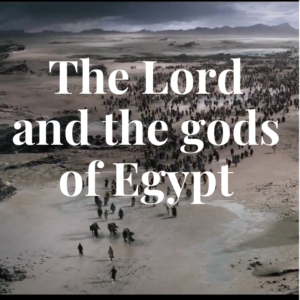
So Moses and Aaron return to Pharaoh and begin the contest of whose god is the God of all. All Bible scholars point out that the Egyptians were not monotheists (believing in one god of all) but Pantheists (believing in many gods) and that we must remember that Pharaoh was considered a god as well. So what happens next and the plagues that follow all represent the God of Israel showing the Egyptians and particularly Pharaoh that The Lord and God of Israel is stronger and more powerful than all of Egypt’s gods with a small g.
So Moses and Aaron arrive to see Pharaoh and Aaron throws down his staff and it turns into a snake. Pharaoh is not impressed. He calls on his magicians who also throw down their staffs which turn into snakes. But Aaron’s snake, representing the power of the God of Israel eats all the other snakes. I remember that this impressed me as a child watching the movie the 10 Commandments but it really didn’t matter to Pharaoh. Staffs into snakes was magician 101.
Then came the series of plagues. First was the Nile turning into blood, then the frogs covering every imaginable place. And these also did not change the heart of Pharaoh or even excite him as his magicians were still able to duplicate these signs. It is written that Pharaoh’s heart was hardened.
But after the third plague, which was the gnats, caused the magicians to declare to Pharaoh that this was the work of God with a capital G. But still Pharaoh was not moved.
It is about this time that Moses’ demands to Pharaoh shift a bit. Clearly Pharaoh is unmoved by these displays of God’s power but instead of negotiating down his demands, they seem to get bigger. We are no longer talking about the Jews leaving for three days to worship God during a festival but he has moved up the ante. Moses says, ‘Let my people GO!!!!’
The fourth, fifth, and sixth plagues are flies, diseased livestock, and boils. These only affected the Egyptians. Nothing occurs to the Jews or their property. At this point Pharaoh is finally paying a bit of attention. He asks Moses to pray to his God and even goes so far as to say that Moses and Aaron can leave Egypt for three days to make a sacrifice to God so that the plagues would go away. Pharaoh changes his mind about allowing the Jews to leave for three days but each time, Moses prays to God and the plagues are taken away.
The seventh plague was thunder and hail. And this one must have scared Pharaoh as he not only allowed Moses to leave the city to pray but Pharaoh also admitted his sin. He says that the Lord is in the right and that he and his people are in the wrong. Moses prays for the awful weather pattern to leave and once it does, Pharaoh goes back on his feelings. Buyer’s remorse? My guess is that there is a lot at stake here for Pharaoh. He is supposed to be a god and here this other God is making him look bad. His authority is at risk. The gods with small g’s might be done in by the God of Israel, but Pharaoh was not going to give up his power that quickly. His heart is hardened once again.
The eighth plague is the locusts. Now I don’t know if you have ever been in a farming community in the Midwest when the grasshoppers swarm but this must have been really, really bad. These bugs can take down an entire year’s crop and every green plant in a day. Pharaoh’s officials finally beg him to let these people go. And pharaoh must have realized his power base was now shifting but after asking Moses to please make the locusts go away, his heart had not changed.
So, God tells Moses there will be a final plague…. One where the firstborn in every Egyptian household will be killed. This will be the final one. And Moses goes to Pharaoh to warn him what will happen if he does not let his people go, and Pharaoh unfortunately is still unmoved. His thirst for power and his elf aggrandizement is in the end, his curse.
So we end this morning at the cliff hanger. The message could not have been clearer to Pharaoh, but still, he could not give in. And….We know what will happen next. Stay tuned for next week’s sermon! Dear Lord!
So what is our message here? The story is so fantastic that we could get all caught up in the plagues and the monstrous havoc they put on the people of Egypt. Just like how even though we don’t want to, we still become the gawkers who drive slowly by the car accidents not wanting to look but still being compelled to see it.. Likewise, the plagues intrigue us. But as I thought about it this past week, I thought that the character we might want to focus on is Pharaoh. I mean, really, what is his problem? Can’t he see what a mess he is making out of his society, the pain he is forcing his people to endure, and that he is not acting in the responsible manner that his position in life requires that he do.
As a leader, Pharaoh wears a mantle of responsibility. He is his people. Their welfare is his welfare. But his inflated ego that no longer can perceive reality and his self-centered worry of a God being greater and more powerful than he has put the Egyptian people in great danger. In the beginning of this power match between Moses (representing the Lord God of Israel) and Pharaoh; Pharaoh has the backing of the Egyptians. They want their guy to win. The magicians are brought in to support Pharaoh’s side. And they do, until they realize that Moses’ God is all powerful. The intensity and pain the Egyptian people must endure keeps on being ramped up as each plague is brought upon them. And these plagues are brought upon them because Pharaoh cannot give in to the authority of the Great I Am. To do so would be for pharaoh to give up his power over the Israelites. Finally Pharaoh’s advisors say to give in but even then he cannot. To do so, would be to admit Yahweh was Lord of all….. And this, dear friends, is our message.
We cannot be god and be a healthy individual. It is important for our well-being to have something that is greater than us. Pharaoh was his own god and because of that was destined to make poor judgements as a leader. He could not give in to the demands made by Moses and Aaron, because to do so, would be to put God in a higher plane than he put himself. His people suffered greatly from his misplaced sense of himself.
We need God as having someone/something/some power greater than ourselves allows us to see realities, put things in a proper perspective, and weather the highs and lows in life correctly.
How can we enter into healthy relationships and friendships with people if we don’t think that there is something greater than ourselves?
Unfortunately poor Pharaoh did not learn that lesson and it was his people who suffered so greatly. It is indeed a good lesson on which we should meditate. Amen.