
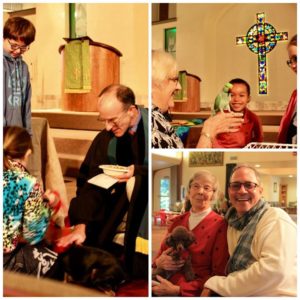
The Rev. Gerry Gregg died this past year. There is no reason why you would know him. His pastorates that I am aware of were outside Chicago and in Columbus Ohio. Gerry was a man who never liked the spot light, a person who felt called to a ministry of promoting social justice issues, and although an excellent preacher, always said he never felt called to be the senior pastor of a church. I knew him when we were both working at Broad Street Presbyterian Church, the large downtown Presbyterian Church in Ohio’s capital city. Gerry was a runner before running was popular, a cabinet maker and carpenter, and a man of great humility. When Gerry was called on to preach, he often would take a figure from history and tell their story and we called it his ‘Faith Hero Series’. His faith heroes included Martin Luther King and Sojourner Truth, Biblical figures such as Amos of Tekoa, and little known historical figures like John Wycliffe. At his retirement these sermons were bound and made into a book. So, as we approached the annual Blessings of the Animals at Riviera, I thought I would find Gerry’s book and see what he wrote about St Francis, the saint of the animals and natural world. Alas, Gerry never preached on him. So, after much research, Gerry, my dear friend now in heaven, this sermon is for you.
It is interesting to research a historical figure from modern eyes. We tend to judge them from our vantage point and forget that they lived in a particular era and what was written about them was written from that era. Francis is a 13th century holy man. He was from Assisi and lived at a time when Pope Innocent III ruled the church and Italy was not a united nation but a group of small villages who fought with each other. Francis was born in either 1181 or ’82 into a very wealthy silk merchant’s family. His name was Giovanni di Pietro di Bernardone. His family and friends called him Francesco. As a child he was indulged. He was a handsome young man who was known for being witty, gallant, and delighted with fine clothes. He was, you might say, a medieval swank… a playboy who could have bawdy behavior in the pubs as banged his tankard on the table for more ale and flirted with the females who were present.
As a young man, he joined the army of men protecting Assisi and in a battle against Perugia in 1202 he was taken prisoner at Collestra. He spent months as a prisoner of war in a medieval dungeon and when released, he returned to his carefree life but his friends all noticed, the experience had taken a toll on him both physically and mentally. He was of frail health. He appeared a bit spaced out and seemed removed from his prior life in both space and time. Something had changed. He lost his taste for fine things and his carefree manner had disappeared. Perhaps today we would say he suffered from PTSD. But whatever happened, it allowed him to become the faith hero we think of today.
Fransesco tried to return to his family business selling fine linens. It seems that a breaking point happened one day when Francis was conducting business and a beggar came into the shop. The stories here are varied, but after the sale was finished, he either he gave the beggar bales of imported fine linen or all the money that was on him or in the shop. It was, at any rate worth a small fortune. His friends chided him for his behavior and his father went berserk with anger. Clearly this was the straw that broke the camel’s back with his father’s patience with his son’s personality change. Clearly his actions were not in line with what society and his family expected of him. It is hard for me, as a 21st century person to not want to diagnose what might be happening to poor Francis in terms of our psycho analytic terms here, but I have to resist as it that science was not available then.
Some sources say that all the money and the linens were recovered but all say that Francis’ father threatened to take him to court to disown him. But before that could happen, his father had Francis before the Bishop in the town square of Assisi. Perhaps his father thought the bishop could talk some sense into the young man. In the conversation the father threatened to disown him and Francis replied that he could not as he was no longer his father, he only had one Father and that one was in heaven. At that point, Francis realized he owned nothing, even the clothes on his back, so he took them off and handed or threw them at his father. It is said that the Bishop covered Francis’ nakedness with his own cloak.
Francis had nothing and became a beggar. This is when his ministry began.
Listen now to the first Scripture lesson for this morning, from Paul’s letter to the Galatians 6:14-18. It is said to be a passage which was a guide for Francis in his ministry.
May I never boast of anything except the cross of our Lord Jesus Christ, by which[a] the world has been crucified to me, and I to the world. 15 For[b] neither circumcision nor uncircumcision is anything; but a new creation is everything! 16 As for those who will follow this rule—peace be upon them, and mercy, and upon the Israel of God. 17 From now on, let no one make trouble for me; for I carry the marks of Jesus branded on my body. 18 May the grace of our Lord Jesus Christ be with your spirit, brothers and sisters.[c] Amen. The Word of the Lord. Thanks be to God.
Francis gave up his friends. He joined beggars at St. Peter’s Basilica while on a pilgrimage to Rome. While praying at the country chapel of San Damiano outside Assisi he had a vision where the crucified Christ on the crucifix above the alter spoke to him. The vision said, ‘Francis, Francis, go and repair My house which, as you can see, is falling to ruins’. Francis felt he had his first calling and began to beg for stones for the restoring of San Damiano. And Francis, in his ministry, restored this chapel and several others including St. Mary’s of the Angels which he considered his favorite.
But as you know this was not all for which he is remembered. In February of 1208, after hearing mass and the reading of Christ commissioning the 12, he was inspired to formalize his life of poverty. He became a sort of country preacher, even though he had no license to do it, and within the first year he had a dozen followers. They all practiced poverty. One day while traveling down a road, Francis embraced a leper which was unthinkable. It started a ministry to care for lepers. Francis’s ministry and followers continued to grow rapidly. Within two years, Francis had so many followers that the Franciscan Order was founded by the Pope. At first, its only rule was ‘to follow the teachings of our Lord Jesus Christ and to walk in His footsteps’. Francis discovered in the poor, the abandoned, and the no-bodies in society the face of Christ. And in associating with the poor, he discovered from them what the rich look like. You might say, this Franciscan Order was the first to espouse what we later called Liberation Theology. It called for justice and a solidarity with the poor, the powerless, and the oppressed.
Francis left quite a legacy. His dedication to imitate the life and carry out the work of Christ is still felt in the men’s orders of Friar’s Minor, the women’s order of St. Clare, and of course the 3rd order of St. Francis. He celebrated and venerated poverty and nature. Francis thought nature was the mirror of God and that all creatures were his brothers and sisters. Statues and paintings of him often portray him with a wolf at his feet or his hand outstretched holding a dove. These come from stories of how he preached to the birds and they listened and that he tamed a man-eating wolf by talking to him and working out a deal with him that he would be fed by the people of the village if he no longer killed. In his canticle of the Son or as it is also called the Canticles of the Creatures, Francis mentions Brother Sun and Sister Moon, wind and water and even Sister Death. All of nature was related and a part of God’s family. He even referred to his chronic illnesses in terms of sisters.
The Catholic Church reveres him for several things we might not know about him. He arranged for the first live nativity scene at Christmas in 1220. He used real animals so the worshippers could contemplate the birth of Jesus using all their senses, especially sight. It is recorded that he received stigmata in 1224, making him the first recorded person to receive the wounds of Christ.
Francis died on October 3rd 1226 while listening to a reading he requested of Psalm 142. He was canonized two years later and became the Patron Saint of Italy. Later he also became the Saint of animals and the natural environment. It is customary to bless animals on his Feast Day which is October 4th, but we here at Riviera wait until January when the animals won’t be hurt by the heat of tropical Florida.
As I think of his legacy… his calling to the poor and the under privileged in our society and his belief that all creatures should praise God, he truly is a faith hero. He spoke to our duties as faithful people. God’s planet is a sanctuary. We have a duty to protect and enjoy all nature as stewards of God’s creation and as creatures ourselves and that we have a duty to all our brothers and sisters, whether they be the poor, the outcast, the garden in our yard, or the pets we are to bless this morning. I close with the second scripture passage for today from the Gospel of Matthew 5:3-4, 6. Listen again for God’s message.
3 “Blessed are the poor in spirit, for theirs is the kingdom of heaven.
4 “Blessed are those who mourn, for they will be comforted.
6 “Blessed are those who hunger and thirst for righteousness, for they will be filled. Amen.